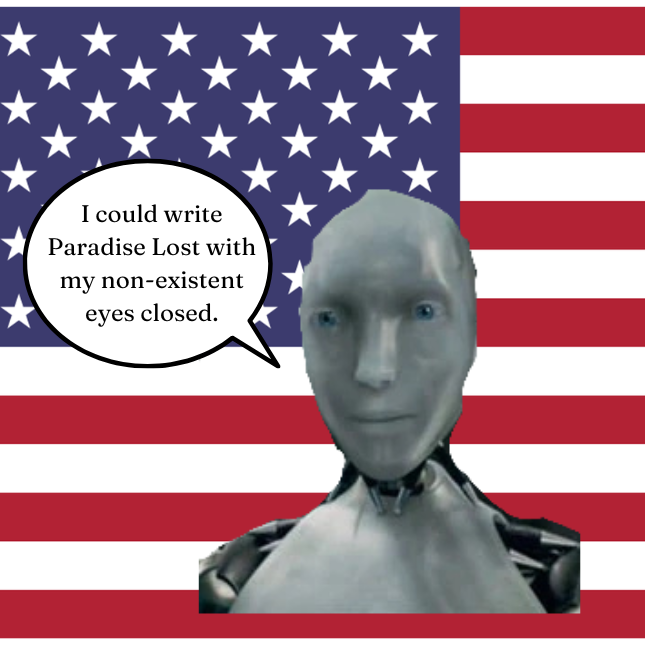
…it was during the blip that one of the oddest trends in cultural history took form. Literary critics began to argue that many famous works of art were not actual historical artifacts, but rather the results of generative “artificial intelligence” (for clarification, not our actual AIs, just large language models). Let us take the influential work of Dr. Sarah Bernard as an example.
In 2085, Bernard published a book called Contemporary Hallucinations in Literary History. The sixty-year-old literary critic made many arguments about engaging with literature in the age of physical scarcity and “AI.” But chief among them, she argued, was that there was no way to know whether certain texts were really physical/historical texts at all.
She gave the example of John Milton’s Paradise Lost. She argued that, since most physical copies had been destroyed (along with most textual artifacts, literary or otherwise), we could no longer have epistemological certainty that John Milton wrote the text. “For all we know,” she writes, “Someone in the 2020s or 2030s commanded an LLM to construct ‘An Epic Poem in Blank Verse About Adam, Eve, and Satan, with a Focus on the Interplay Between Theology and 16th-17th Century English Politics.’”
Now, whether or not Bernard meant what she said literally is a matter of about one hundred years of literary dispute. Early academics who engaged with her work were quite certain she did not mean that we do not know who wrote Paradise Lost. Rather, they viewed what she said as a play or inversion on the “Death of the Author” theory. In the age of “AI,” the role of authorship between actual historical humans and language models was blurring. If machines could generate text, are the machines authors? One passage from Bernard’s text heavily favors this more reasonable line of thinking: “Consider this: a man with no knowledge of Chinese asks a model to construct a Chinese novel in the tradition of the four infamous Chinese Classics. To those unfamiliar with these novels and their contexts (which span hundreds of years), it would be almost impossible to discern among the texts which Chinese Classics are legitimate and which one is not. It’s preposterous to think someone with no knowledge of Chinese history, language, or culture could write one of the Chinese Classics. So then, is the LLM the ‘author’ of it? Did it write the text or just conglomerate ideas until something fit the prompt? That would be more like solving a puzzle than writing…”
With the ban of most physical media, however, some critics began to reassess Bernard’s position. “It is reasonable to assume, based on the style,” writes Josh Levingston, a professor of English at Harvard, in 2123, “that Milton is no more than code for a model, and that Paradise Lost is a generated text.” Over the next couple of decades, this became the standard interpretation of Paradise Lost: that it, and many other texts, were not true historical artifacts, but inventions of the 2020s and, in some cases, into the 2040s.
Ely Crenshaw, writing in 2124, notes, “My opinion on the matter of Milton lies somewhere in the middle of my contemporaries. Like Homer, surely there was an ur-text, either of the written or oral tradition. Given the many specific story-beats in the text that differ from the Biblical inspiration, I imagine there was some sort of text that the prompter gave to the LLM to ensure a faithful recreation of the story they’d heard or read and were trying to tell.”
The same Ely Crenshaw tried a radical experiment that failed wonderfully. He took the most advanced LLM of the time and asked it to pretend to be John Milton. Because the only authorized historical texts came in the form of state-sanctioned documentaries, there was little real info about Milton. When Crenshaw asked the Milton-“AI” a few questions (“Who did you support in the English Civil War?”), the “AI,” projecting a proposed image of Milton on the monitor, shot himself in the face, refusing to say more.
This is characteristic of the blip: a complete breakdown in understanding how knowledge is received and carried on. Keep in mind that the best-selling books between 2035-2190 were generated, not written. But in the opinion of the populace and the literary elite, this did not really matter.
If something sells, it is real. At first, very early on, “AI” generated images and music were used for things that were viewed as low-art: commercials, ambient music in malls and stores, billboards, pornography, etc. Nobody minded this (except those who once made the art or acted, of course). These were not “art forms of consequence” in the imaginations of that generation. But one day a very important Image-Story (then called a “comic”) starring the still-infamous Batman reached the best-sellers list; it was completely made with AI, and proudly so. It sold like nothing before it. In ten years’ time there were no more physical comics; all of them were digital and all of them were created with “AI.”
From out the comics, the technology crept its way into mainstream music, literature both genre-based and academic, and because, and only because, people actually bought these things, this trend proliferated. In 2047, the first completely “AI” movie to win best picture, Visions of Nagasaki, was released to enthusiastic reviews. “It appears,” wrote one anonymous critic in the long-defunct Washington Post, “That AI is finally powerful enough to do what we always dreamed.” At the award ceremony there was no director to accept the award, and instead the company’s producer, an inebriated man in a white tuxedo thanked “All those megalobites [sic] of RAM we bought.”
We digress. By now we mostly know why most physical media was destroyed, and the answer is very silly but nevertheless tragic: people would not use these “AI” products forever; their novelty wore off quickly; but if you had no alternative, what else would you do?
It is why, returning to Sarah Bernard, we ought not to harbor much hatred. In a rapidly changing world, she tried to philosophize, and that is not a crime. If anything, we should pity her and her academic offspring. When LLMs were finally banned in 2204, the blip did not end at once, but many hidden libraries were found, and many texts and authors were recovered; Milton was not among them.
I suppose if there’s someone we should pity, it is John Milton, whether he really existed or not.
The next hundred years were a time of optimism and…